

When the Government of India replaced the old Udyog Aadhaar Memorandum (UAM) system with the new Udyam Registration Portal in July 2020, the objective was to create a more trusted, transparent, and fully digital MSME recognition system. Today, every business that was earlier registered under Udyog Aadhaar must complete the migration to the new Udyam portal to continue enjoying MSME benefits.
This guide explains how to migrate Udyog Aadhaar to Udyam, the required documents, eligibility conditions, common issues, and a detailed step-by-step process to help you complete your transition smoothly.
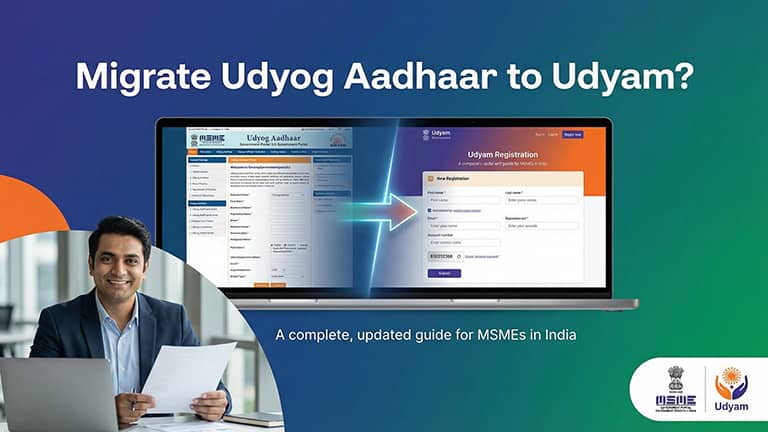
Want to register your Udyam?
Apply online in minutes — get your Udyam Aadhaar certificate hassle-free.
What Is Udyog Aadhaar and Why Migration Is Needed?
Udyog Aadhaar was an earlier MSME registration system that allowed small businesses to obtain a unique 12-digit UAM number by using basic details such as Aadhaar, PAN, and business information.
However, the system lacked verification accuracy and did not integrate fully with government databases. Therefore, the government launched the Udyam Registration system, which is:
- Aadhaar- and PAN-based
- Fully automated
- GST-linked
- Valid for lifetime
- Required for availing MSME schemes, subsidies, and loans
Because of these improvements, all MSMEs must complete the Udyam migration process to continue enjoying government support.
Who Needs to Migrate MSME Registration?
You must migrate if:
- You have an old Udyog Aadhaar Memorandum (UAM) number.
- Your business is still active.
- You want to access MSME benefits such as subsidies, bank loan schemes, ISO reimbursement, and more.
- You need a valid MSME certificate for tender participation, trade licenses, or export registrations.
If you do not migrate MSME registration, your old UAM number will no longer remain valid under the current government framework.
Documents Required for Udyog Aadhaar Migration
To complete the migration, keep the following details ready:
- 1. Aadhaar Number of the business owner
- 2. PAN Card of the business owner or enterprise
- 3. Udyog Aadhaar Number (UAM No.)
- 4. GSTIN (mandatory for all GST-registered units)
- 5. Business Details such as type of organization, official address, and bank information
- 6. Investment and Turnover Details (auto-fetched for GST holders)
Having these details prepared will help you complete the migration faster.
Benefits of Migrating to Udyam Registration
Migrating ensures that your business receives continued support from the Ministry of MSME. Once the Udyog Aadhaar migration steps are completed, you unlock:
- Lifetime validity MSME certificate
- Faster approvals for bank loans
- Lower interest rates under CGTMSE scheme
- Eligibility for subsidies and incentives
- Priority sector lending benefits
- Protection against delayed payments
- Easier participation in government tenders
- Access to MSME grievance and support systems
These benefits make migration essential for long-term business growth.
Step-by-Step Guide: Udyog Aadhaar Migration Steps
Here is a complete breakdown of how to migrate Udyog Aadhaar to Udyam quickly and correctly.
Step 1: Visit the Official Udyam Registration Portal
Go to the official portal. This is the only government-recognized platform for MSME registration and migration.
Step 2: Select the Option for Migration from UAM
On the homepage, look for the option that says “For those having Udyog Aadhaar (UAM)”. This section is specifically designed for businesses that need to migrate MSME registration.
Step 3: Enter Your UAM Number and Mobile Number
You must enter:
- Your Udyog Aadhaar Number
- The mobile number that was previously linked to UAM
An OTP will be sent for verification.
Step 4: Verify Your Identity Using OTP
Enter the OTP received on your registered mobile number. If your mobile number is no longer active, you will need to update it or use Aadhaar-based OTP verification.
Step 5: Provide the Required Aadhaar and PAN Details
The portal will ask you to enter the Aadhaar number of the owner/authorized signatory. Next, you must enter your PAN number. PAN verification is mandatory under the new MSME rules.
Step 6: Fill in Business Information
During the Udyam migration process, you must confirm or update:
- Business name
- Type of organization
- Business activity (manufacturing or service)
- NIC code of activities
- Official address
- Bank details
- Employee count
Ensure that every detail matches your GST and income tax records.
Step 7: Enter Investment and Turnover Information
The portal automatically fetches your investment and turnover details from:
- Income tax database
- GST database
For businesses not required to register under GST, you may enter the details manually.
Step 8: Submit and Generate Udyam Registration Certificate
After verifying all details, submit the application. Upon successful submission, you will receive:
- A 16-digit Udyam Registration Number (URN)
- A downloadable Udyam Registration Certificate
This certificate is valid for your lifetime and does not require renewal.
Common Issues While Migrating Udyog Aadhaar to Udyam
Although the process is simple, some users face issues. Here are the most common ones:
- 1. Incorrect Mobile Number Linked with UAM
If you no longer have access to the mobile number used during UAM registration, you may face difficulty receiving OTP. - 2. PAN and Aadhaar Mismatch
Your Aadhaar details must match the PAN database. Any spelling or DOB mismatch can delay migration. - 3. GST Linking Errors
If you are GST-registered, your GSTIN must match the PAN and Aadhaar details of the enterprise. - 4. Multiple UAM Numbers
Some businesses may have more than one UAM number. In such cases, all numbers must be linked and migrated carefully.
How to Check Udyam Migration Status
Once you complete the migration, you can check your registration status online by entering:
- Udyam Registration Number
- Registered mobile number
This helps verify whether your business has been successfully migrated.
Do You Need to Update Details After Migration?
Yes, you must update business details if:
- You change your business address
- You add new activities (new NIC codes)
- Your GST status changes
- Your business hires more employees
The Udyam portal allows unlimited updates without additional fees.
Importance of Migrating Before Applying for MSME Benefits
Government departments, banks, and financial institutions now require a valid Udyam Registration Certificate before providing benefits such as:
- Mudra Loans
- SIDBI schemes
- NSIC subsidies
- Tender exemptions
- ISO reimbursement
- Electricity concessions
Without migration, your business may lose eligibility for these benefits.
Final Thoughts
Migrating from Udyog Aadhaar to the new Udyam Registration Portal is essential for every MSME in India. The process is simple, quick, and fully online. Completing the migration ensures that your business remains recognized under the current MSME framework and continues to receive government support.
By following the above Udyog Aadhaar migration steps, you can complete the transition smoothly and obtain your lifetime-valid MSME certificate.
If you are an entrepreneur or business owner still using an old UAM number, now is the best time to migrate MSME registration and secure your access to all the benefits offered under the updated Udyam system.